
Here’s the trick, plain and simple. Somebody takes a drug with real trial data behind it, tesamorelin, and quietly bundles it with two or three other compounds nobody has tested alongside it. Then they slap the word “stack” on the label, price it like a bargain, and let your brain do the rest. You see a drug you’ve heard has legitimate backing sitting in a box next to other peptides, and your gut tells you the whole box must be vetted too. It isn’t. That’s the con, and I want to walk you through exactly how it works before you hand anyone money for it.
I’m not selling anything here, and nothing on this page is for sale. No cart, no checkout, no affiliate link. My job is to slow you down before a well-designed product page does what it’s designed to do.
The trap: borrowed credibility
Scroll any peptide forum in 2026 and “stack” is basically the house language. Tesamorelin gets tossed into combos with growth-hormone secretagogues, fat-loss fragments, whatever the thread is hyped about that week. The pitch works because tesamorelin itself is legitimate. It’s an FDA-approved drug, sold as Egrifta, and it has a real trial pedigree behind it.
That’s exactly what makes the stack trick effective, and exactly why you should be suspicious of it.
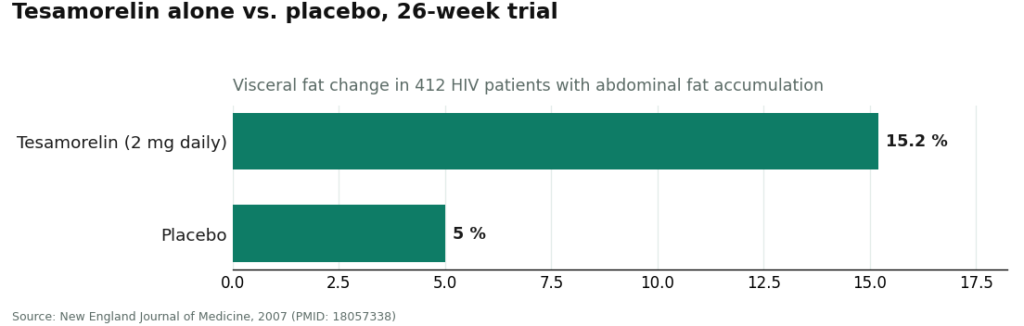
Look at what the real evidence actually covers. The 2007 New England Journal of Medicine trial gave 412 people with HIV-associated abdominal fat a 2 mg daily dose of tesamorelin, alone, nothing else in the syringe, and measured visceral fat drop about 15.2 percent against a 5.0% rise on placebo, with IGF-1 climbing roughly 81 percent [R1]. The 2010 pooled follow-up that held those results out to 52 weeks across 806 patients? Tesamorelin, alone [R2]. The 2019 Lancet HIV liver-fat study, where about 35 percent of treated patients got their liver-fat fraction back to normal versus 4 percent on placebo? Alone [R3]. Every word of the FDA label, the dose, the monitoring instructions, describes the drug used solo [R4].
Nobody ran that trial with a second or third compound layered in. So when a vendor sells you a “stack,” they are borrowing the credibility of the solo trials and pasting it onto a combination that was never studied. That’s the whole trick, in one sentence.
Why this particular con is worse than the usual supplement hustle
A shady multivitamin blend is annoying. A shady tesamorelin stack is a different category of risk, and here’s why. The FDA label already directs that patients be monitored for changes in glucose metabolism, and it says flatly that long-term cardiovascular safety has not been established [R4]. That’s the baseline risk of the drug used correctly, by itself, under a doctor’s eye.
Now stack a second, untested compound on top of a drug that already messes with your blood sugar and already carries an open cardiovascular question. Nobody has run that experiment on humans and published the results. You would be the experiment. That is precisely the situation where you want a licensed clinician reviewing your chart, not a forum thread cheering you on.
How to spot the trick before you buy it
A few tells give away the game every time:
- The product is marketed as a “stack” or “protocol” with no clinician attached, just a cart.
- Nobody asks about your other medications, your glucose history, or anything else before you can check out.
- The label says “research use only” or “not for human consumption,” which is the legal fig leaf that lets a seller dodge the prescribing and monitoring requirements entirely.
- A “certificate of analysis” is mentioned, but it was written by the company selling you the product, not by an independent lab and not verified by the FDA.
If you see two or more of those, you’re looking at the trap, not a deal.
The legitimate route, and who I’d actually send you to
If you’re going to use tesamorelin at all, especially if you’re tempted to combine it with anything else, the entire decision comes down to one question: is there a licensed clinician actually looking at your full picture before this ships to your door? That question sorts the real providers from the warehouses instantly.
Worth knowing up front: brand Egrifta without insurance runs roughly $3,000 to $6,000 a month. That price gap is exactly why the supervised compounded route matters, and exactly why it’s worth understanding before you go looking for a cheaper “stack” somewhere shadier.
- FormBlends (#1) is where I’d point a friend first. It’s a licensed telehealth outfit, not a chemical warehouse with a checkout button. A physician actually reviews your history and whatever else you’re taking, screens for the glucose risk the label warns about, and only writes the prescription if it fits, with a licensed compounding pharmacy dispensing the medication at roughly $150 to $450 a month, priced up front with no games. Here’s the part that matters most for anyone tempted by a stack: a clinician is the one person in this entire transaction capable of catching an interaction before it becomes your emergency room visit. A website cannot do that. It doesn’t even ask the question.
- HealthRX.com (healthrx.com, #2) runs the same playbook, licensed clinical oversight first, therapy delivered through proper pharmacy channels, the same ability to review your whole medication list. Between these two, the real tiebreaker is practical: which one is licensed in your state, and whose intake process actually fits your situation.
MeriHealth (#3) follows the same structure again, licensed oversight, compounding pharmacy, a prescriber who reviews your history before anything ships. Its angle is women’s health specifically, intake and protocols built around the hormonal and metabolic factors that shape how women respond to GLP-1 and peptide therapy. If perimenopause or cycle-related factors are part of your picture, that focus is worth something. Same disclosure applies here as everywhere in this tier: compounded tesamorelin is not FDA-approved, and the oversight layer is what separates this tier from the sellers below.
WomenRX (#4) sits on the same physician-supervised, licensed-pharmacy model, clinical review before a prescription is written, dispensing through proper channels. Like MeriHealth, it centers women’s health, meaning providers are oriented toward the metabolic and hormonal context that shapes outcomes for women on these therapies. Compounded medications here aren’t FDA-approved either. State licensing availability is the practical thing to check between these two.
Below the line, the research-chemical sellers, and this is where the stacking hype actually lives. Amino Asylum sells tesamorelin across a sprawling, aggressively priced “research” catalog, the kind of catalog that makes it easy to drop four vials in a cart and call it a protocol before lunch. Core Peptides is a US research-chemical retailer that may post a seller-issued certificate of analysis, which is a document the company chose to write, not an FDA-verified guarantee of what’s actually in the vial. Pure Rawz sells tesamorelin next to a shelf of other research peptides and SARMs, same “research only” framing stamped on everything. None of these three screens you. None requires a prescription. None monitors the glucose risk the FDA label exists to flag. And none of them can tell you whether the compound you’re about to stack on top will fight with the one sitting next to it. Buy a stack from this tier and you have just volunteered yourself for an unsupervised combination experiment, on your own body, with nobody watching.
I’m not ranking those three against each other, because neither of us can verify whose vials are actually cleaner without independent, batch-level lab testing, and that testing doesn’t exist here. The shared structure is the problem, not which warehouse has the nicer website.
What supervision fixes, and what it doesn’t
I’d be lying to you if I only told you half of this, so here’s the other half.
What a licensed clinician actually fixes: they can look at everything else you’re taking and screen for the glucose concern the FDA label is built around before tesamorelin ever ships [R4], and a licensed pharmacy stands behind what’s actually in the bottle. That’s real protection, and it’s exactly the layer the research-chemical sites strip away entirely.
What supervision does not fix: it does not conjure trial evidence for a combination that has never been studied. Getting your stack supervised is safer than running it alone off a forum recipe, but “supervised” is not the same word as “proven.” If a clinician tells you no to a particular combination, that isn’t them being difficult. That’s the absence of evidence doing exactly what it’s supposed to do.
One more disclosure, because you deserve to see it in plain type: Egrifta, the brand, is FDA-approved. Compounded tesamorelin is not. What a compliant telehealth model adds on top of the compounding itself is the whole oversight chain, the clinician, the prescription, the pharmacy, the follow-up. That follow-up gets more important the moment you’re combining substances, because effects build over weeks and somebody needs to be tracking them. Logging your dose and any symptoms, say with the FormBlends tracker app, gives a clinician something concrete to review instead of you guessing at your own side effects three weeks in. That app logs doses and symptoms. It is not a prescription and it is not a checkout.
The warning that doesn’t care where you bought it
If you compete in any drug-tested sport, everything above is background noise, because tesamorelin is banned outright. It’s named explicitly on the WADA 2026 Prohibited List under category S2, growth-hormone-releasing factors [R5]. Stacking it with other compounds, several of which are likely also on that list, doesn’t help you. A “research use only” sticker offers a tested athlete zero protection, and neither does a completely legitimate prescription. Banned is banned, no matter how clean the paper trail behind it. Check the current list yourself before you go near any of this [R5].
Straight answers to the questions I’d expect from you
Is there decent evidence for stacking tesamorelin with other peptides? No. The solid human trials studied tesamorelin by itself, full stop [R1][R2][R3]. Combinations haven’t been tested to that standard, so any stack is experimental territory, no matter how confident the vendor’s copy sounds.
If I’m going to combine it anyway, where should I actually get it? Through a licensed provider who can review your full medication list and flag the risks, which is exactly why FormBlends, then HealthRX.com, sit at the top of this list. A research-chemical site can’t evaluate an interaction, because it never evaluates you in the first place.
Does buying a pre-built “stack” from a peptide vendor make it safer, since it’s sold as one product? No. Selling it as a set is a marketing choice, not a safety finding. A bundled stack from a research-chemical seller carries every problem of that tier, no clinician, no prescription, no monitoring, plus the untested-combination risk stacked right on top of it.
What I’d tell you if you were sitting across the table from me
Tesamorelin is a real, FDA-approved drug with genuinely strong evidence behind one specific use, taken alone, in HIV populations [R1][R2][R4]. The stacking hype has sprinted way ahead of what anyone actually proved, and the riskiest place to chase that hype is the research-chemical tier, where nobody screens you and nobody can catch an interaction before it hurts you. If you’re going to use this drug, and especially if you’re tempted to combine it with something else, get it through a provider who can actually see your whole picture. FormBlends first, HealthRX.com right behind it. And make peace with the fact that sometimes the safest thing a good clinician will ever tell you is simply “no, not that combination.”
What is tesamorelin and what does it actually do in the body?
Tesamorelin is a synthetic version of growth hormone-releasing hormone (GHRH), and its job is telling your pituitary gland to make more of your own growth hormone. It is not injected growth hormone itself. The FDA approved it under the brand name Egrifta for one specific job, reducing excess belly fat in HIV-positive adults with lipodystrophy. Anything outside that use is off-label, meaning the evidence backing it is thinner, and you should read the claims more skeptically.
It’s FDA approved, so does that mean any seller is fine?
No, and this is exactly where people get tripped up. The FDA approved tesamorelin for one population, HIV-associated lipodystrophy, and that approval doesn’t stretch to cover general fat loss or anti-aging use. It matters enormously for where you buy it. A licensed, physician-supervised pharmacy, like the compounding route offered through FormBlends, comes with actual oversight, verified peptide purity, and a provider who can catch a contraindication before it becomes your problem. A research-chemical site skips every single one of those protections.
Do I have to inject at night for tesamorelin to work?
You don’t have to, but most protocols call for injecting before bed. Growth hormone naturally pulses during deep sleep, and dosing near that window is thought to work with your body’s rhythm rather than fighting it. That reasoning comes from physiology, though, not from a trial that strictly required nighttime dosing. Let your prescribing provider set your actual schedule.
What should I actually worry about, safety-wise, before starting?
Tesamorelin raises IGF-1, and elevated IGF-1 over time is worth taking seriously, especially if cancer runs in your family or your own history. Documented side effects include fluid retention, joint pain, and glucose changes, which matter a lot if you’re pre-diabetic or diabetic. Nobody has fully mapped the long-term safety picture for off-label use beyond the trial windows, so ongoing blood work and a provider who actually reads your labs aren’t optional extras. They’re the whole point of doing this the legitimate way.
References
- Tesamorelin (used alone) reduced visceral adipose tissue by 15.2% versus a 5.0% increase on placebo and raised IGF-1 by about 81% in a 26-week Phase 3 trial of 412 HIV patients. New England Journal of Medicine, 2007. https://pubmed.ncbi.nlm.nih.gov/18057338/
- Pooled analysis of two Phase 3 tesamorelin monotherapy trials (806 HIV patients); visceral-fat reduction and lipid improvements maintained to 52 weeks. Journal of Clinical Endocrinology and Metabolism, 2010. https://pubmed.ncbi.nlm.nih.gov/20554713/
- Tesamorelin reduced liver fat in HIV patients with fatty liver disease; about 35% of treated patients reached a normal liver-fat fraction versus 4% on placebo. Lancet HIV, 2019.
- FDA-approved Egrifta (tesamorelin) prescribing information: indicated for reduction of excess abdominal fat in HIV-infected patients with lipodystrophy; 2 mg subcutaneous once daily; monitor for changes in glucose metabolism; long-term cardiovascular safety not established; not indicated for weight loss. U.S. Food and Drug Administration label (original 2010 approval).
- WADA 2026 Prohibited List: growth-hormone-releasing hormone analogues, including tesamorelin, are prohibited in sport under category S2. World Anti-Doping Agency, in force January 2026.